
 By:
By: Before PDF: The Chaos
It's 1990. You're trying to send a document to a colleague across the country.
You create it in WordPerfect on your IBM machine. They have a Mac running MacWrite. The document arrives looking nothing like what you sent. Fonts are wrong. Layouts are broken. Half your carefully placed images are missing.
This was normal. Sending a document that looked the same on someone else's computer was basically impossible. Every operating system, every application, every printer produced different results from the same file.
John Warnock, co-founder of Adobe, saw this mess and decided to fix it.
The Camelot Paper: Where It Started
On April 1, 1991, Warnock wrote a short memo that would reshape how the world handles documents.
He called it The Camelot Project. In it, he laid out a simple but ambitious goal:
"What industries badly need is a universal way to communicate documents across a wide variety of machine configurations, operating systems and communication networks."
The vision was clear. Any document, from any application, viewable on any display, printable on any modern printer. No more cross-platform headaches. No more "which version of Word do you have?" conversations.
Adobe had already built PostScript, the language that let different printers produce consistent output. Warnock wanted something similar for screens. A document format that would look identical everywhere, always.
1993: PDF Is Born
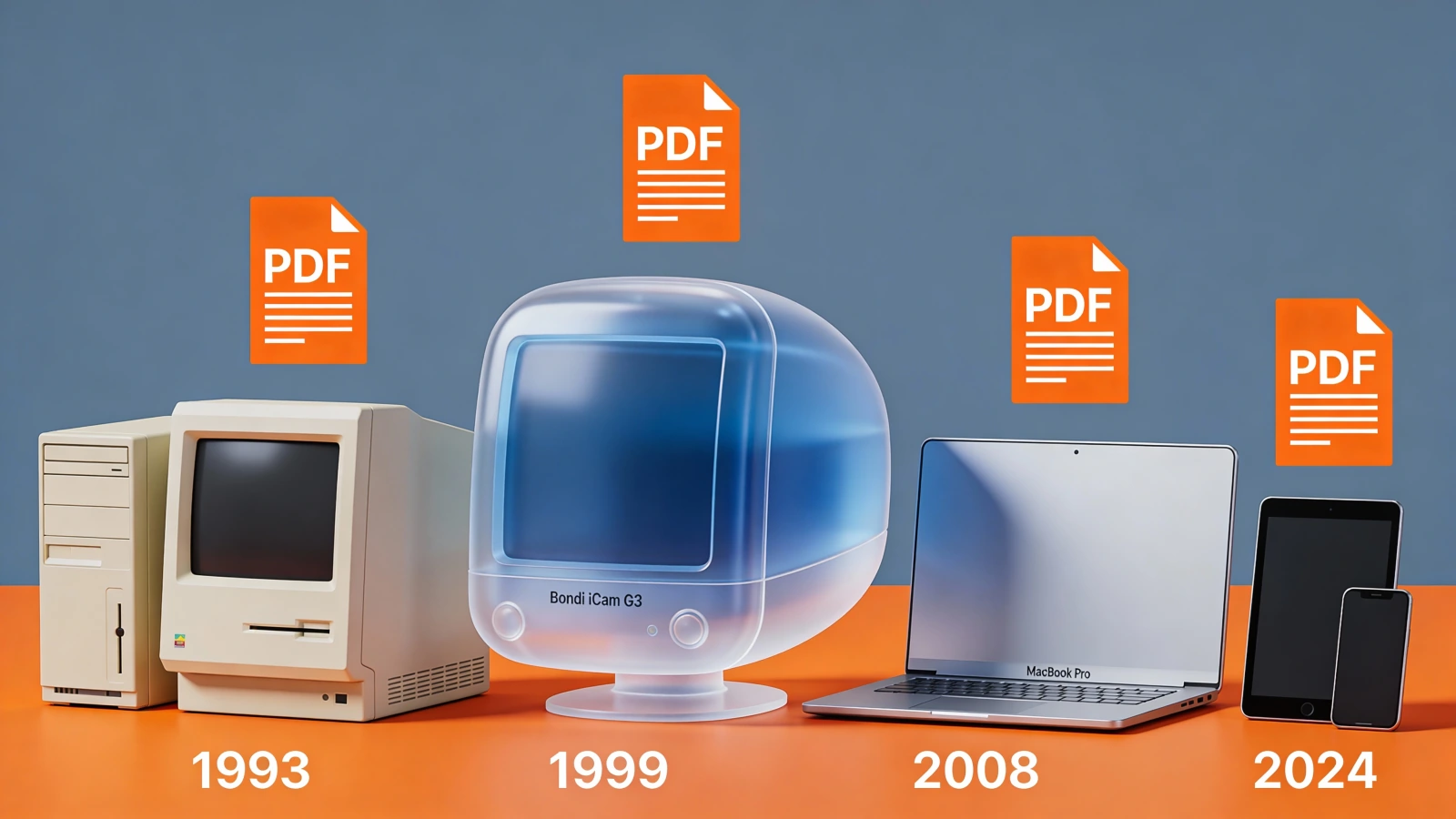
According to Adobe's official history, Adobe Acrobat and the Portable Document Format launched on June 15, 1993, at the Equitable Centre in New York.
The first product suite included three pieces: Acrobat Reader for viewing PDFs, Acrobat Exchange for creating them, and Adobe Distiller for converting PostScript files. PDF 1.0 could handle text, graphics, and fonts. Basic by today's standards, but revolutionary for 1993.
There was one problem. Everyone had to pay.
Acrobat Reader 1.0 cost $50. For software that only let you view documents. This limited adoption to organizations willing to invest in the entire Adobe ecosystem. Regular people had no reason to buy software just to read someone else's files.
1994: The Decision That Changed Everything
Warnock made a gamble. With Acrobat 2.0 in fall 1994, Adobe made Reader free.
The board questioned this. "You're going to give the Reader away?" This was one of the first instances of a major software company giving core functionality away for free.
The bet: if enough people could read PDFs for free, demand for PDF creation tools would follow. Get the reader into everyone's hands, and the format becomes a standard by sheer presence.
It worked. But not immediately. Acrobat lost money for Adobe for about four years after this decision. Four years of waiting for the network effect to kick in.
The same year, Adobe added hyperlinks and password protection to the format. Documents could now link to websites and restrict who could open them. PDF was growing beyond simple document viewing.
The Web Era: PDFs Go Online
Through the mid-to-late 1990s, PDF adoption accelerated alongside internet growth. The format was perfect for the early web.
Need to publish a form online? PDF. Need to distribute a manual without worrying about browser compatibility? PDF. Need to share a document that couldn't be easily edited? PDF.
According to Adobe's timeline, interactive form functionality arrived in 1996, allowing fill-in forms that could be imported, exported, and transmitted via the web. Suddenly, government agencies could put tax forms online. Businesses could create applications customers could complete digitally.
By the early 2000s, PDF had become the default format for anything official. Legal documents. Academic papers. Technical specifications. If it needed to look professional and work everywhere, it was probably a PDF.
2001-2010: Features Pile On
Each new version added capabilities. Adobe's PDF timeline shows the steady expansion:
2001 brought editing and transparency, letting users import one PDF into another. This made PDF a format you could work with, not just read.
Digital signatures became standard. Annotations and comments appeared. Multimedia support meant you could embed video. Security features grew more sophisticated.
PDF was transforming from a document viewing format into a document platform. You could create, edit, annotate, sign, secure, and collaborate. All within the same file format.
But PDF was still Adobe's property. They controlled the specification. They decided what features to add. And that created friction for organizations that wanted to build on PDF without depending entirely on one company.
2008: PDF Becomes an Open Standard
On July 1, 2008, PDF changed hands. Sort of.
Adobe released PDF 1.7 to the International Organization for Standardization (ISO). The result was ISO 32000-1:2008, the first international standard for PDF.
This mattered. A lot.
Proprietary formats die when their owners lose interest or go bankrupt. Standards survive because anyone can implement them. By making PDF an ISO standard, Adobe guaranteed the format would outlive any single company.
The 747-page specification now belonged to an ISO committee of volunteer industry experts. Adobe still influenced development, but they no longer controlled it unilaterally.
Organizations that had hesitated to commit to PDF because of vendor lock-in could now treat it as stable infrastructure. Government archiving systems. Long-term digital preservation projects. Financial records that needed to remain readable for decades.
2017-2020: PDF 2.0 Arrives
Nine years after the first ISO standard, PDF 2.0 (ISO 32000-2) launched in July 2017. A revised edition followed in December 2020.
The updates were mostly technical. Full UTF-8 support meant better handling of international characters. 256-bit AES encryption became the standard for security. Deprecated features from the 1990s got cleaned out.
PDF 2.0 is available at no cost from the PDF Association, sponsored by Adobe, Apryse, and Foxit. The thousand-page specification is public. Anyone can read it, implement it, or build tools around it.
PDF Today: The Numbers
The scale is staggering.
According to Smallpdf's 2025 statistics, approximately 2.5 trillion PDFs exist worldwide. Over 290 billion new ones are created every year, representing 12% year-over-year growth.
The format is everywhere:
- 98% of businesses use PDF as their primary external communication format
- 78% of digital agreements are completed using PDFs
- PDF ranks as the second-most served file type on the web, right after JPEG
The PDF software market was valued at approximately $2.15 billion in 2024, with projections reaching $5.72 billion by 2033.
But here's the interesting part: 63% of PDF viewing now happens on mobile devices. Smartphones and tablets. Yet 72% of PDF editing still happens on desktops.
That gap tells a story. People read PDFs everywhere. But they struggle to work with them on small screens.
And developers who work with PDFs under the hood know the format's quirks better than anyone. As one Hacker News commenter put it: "I still have PTSD from a project where I needed to extract text from millions of PDFs." The thread is full of similar stories. Another described the format as "one step above a JPEG containing the same contents." PDF preserves how a document looks. It was never designed to make that document easy to search, reflow, or pull data from.
What PDF Was Built For (And What It Wasn't)
PDF solved the problem Warnock identified in 1991. Documents look the same everywhere. The format works.
But "everywhere" in 1993 meant desktop computers and laser printers. The iPhone didn't exist. Neither did tablets, responsive web design, or the expectation that everything should work perfectly on a 6-inch screen.
PDF was designed for printing. Fixed page sizes. Fixed layouts. Content that sits exactly where the creator placed it.
This is great when you want precise control. Legal documents, technical drawings, official forms. Anything that might end up on paper.
It's less great when you want documents that adapt. That work naturally on any screen. That let you track whether anyone actually read them. That feel modern instead of like digital paper.
The Next Chapter: Beyond Static Documents
For documents that need to be printed, archived, or legally binding, PDF remains the right answer. It's a genuine engineering achievement that solved a real problem.
But for documents meant to be read on screens, shared widely, and tracked for engagement, the limitations show. That's why formats like flipbooks emerged. Same starting point (often a PDF), different ending experience. Browser-based viewing. Mobile-first design. Analytics showing who read what.
The 30+ year story of PDF proves that good formats can last decades. What Warnock built in 1993 still works. The question is whether "works" is enough when reader expectations have moved so far beyond fixed pages on a screen. If you want to dig deeper, we've covered what PDFs actually are at a technical level, what you can do with PDF tools today, and how flipbooks fit into the evolution from static to interactive.
FAQs
When was the PDF format created?
PDF was created by Adobe and launched on June 15, 1993. The format was conceived by Adobe co-founder John Warnock in a 1991 memo called The Camelot Project.
Is PDF an open standard or does Adobe own it?
PDF became an open ISO standard in 2008 (ISO 32000-1:2008). Adobe released the specification so anyone can implement it without depending on a single company.
How many PDFs exist in the world?
Approximately 2.5 trillion PDFs exist worldwide, with over 290 billion new ones created every year, according to Smallpdf's 2025 statistics.
Why was Adobe Acrobat Reader originally paid software?
Acrobat Reader 1.0 cost $50 when it launched in 1993. Adobe made Reader free in 1994 to drive adoption, betting that widespread readership would create demand for paid PDF creation tools. That bet took four years to pay off.
Can PDFs work well on mobile devices?
While 63% of PDF viewing now happens on mobile, the format was designed for fixed-size printed pages. PDFs don't reflow text for small screens, which is why formats like flipbooks and responsive web content are increasingly used for screen-first documents.