
 By:
By: The Fundraising Black Hole
You sent your deck to a VC at a top-tier firm. Your subject line was perfect. Your intro was warm.
Then... silence.
Did they open it? Did they forward it to a partner? Did it get buried under 200 other decks from founders who also think they're the next Stripe?
You don't know. So you wait three days. Then you send a follow-up that sounds either desperate or presumptuous.
There's a better way.
Why Deck Tracking Matters
Fundraising is part art, part science, and mostly timing.
Here's the reality: DocSend's data shows investors spend less than three minutes reviewing a pitch deck. Successful decks get over four minutes of attention. Unsuccessful ones get roughly ninety seconds. That's the entire window you have before they move on to the next one in a stack of hundreds.
And since decisions usually involve multiple people over multiple touches, not one pass from one person, revisit behavior matters more than most founders think.
A VC who opens your deck at 8am Monday is different from one who opens it at 11pm Friday. One is making time during work hours. One is catching up because they're intrigued.
Digify's fundraising-tracking case examples make the same point from operator experience: access logs are often the earliest reliable signal that investor interest is real.
Knowing when and how they engage changes everything:
- Follow-up timing - Reach out while you're on their mind
- Interest signals - See who's actually looking vs being polite
- Pitch refinement - Learn which slides land and which get skipped
- Partner dynamics - See when a deck gets forwarded internally
What You Can Track
Open Notifications
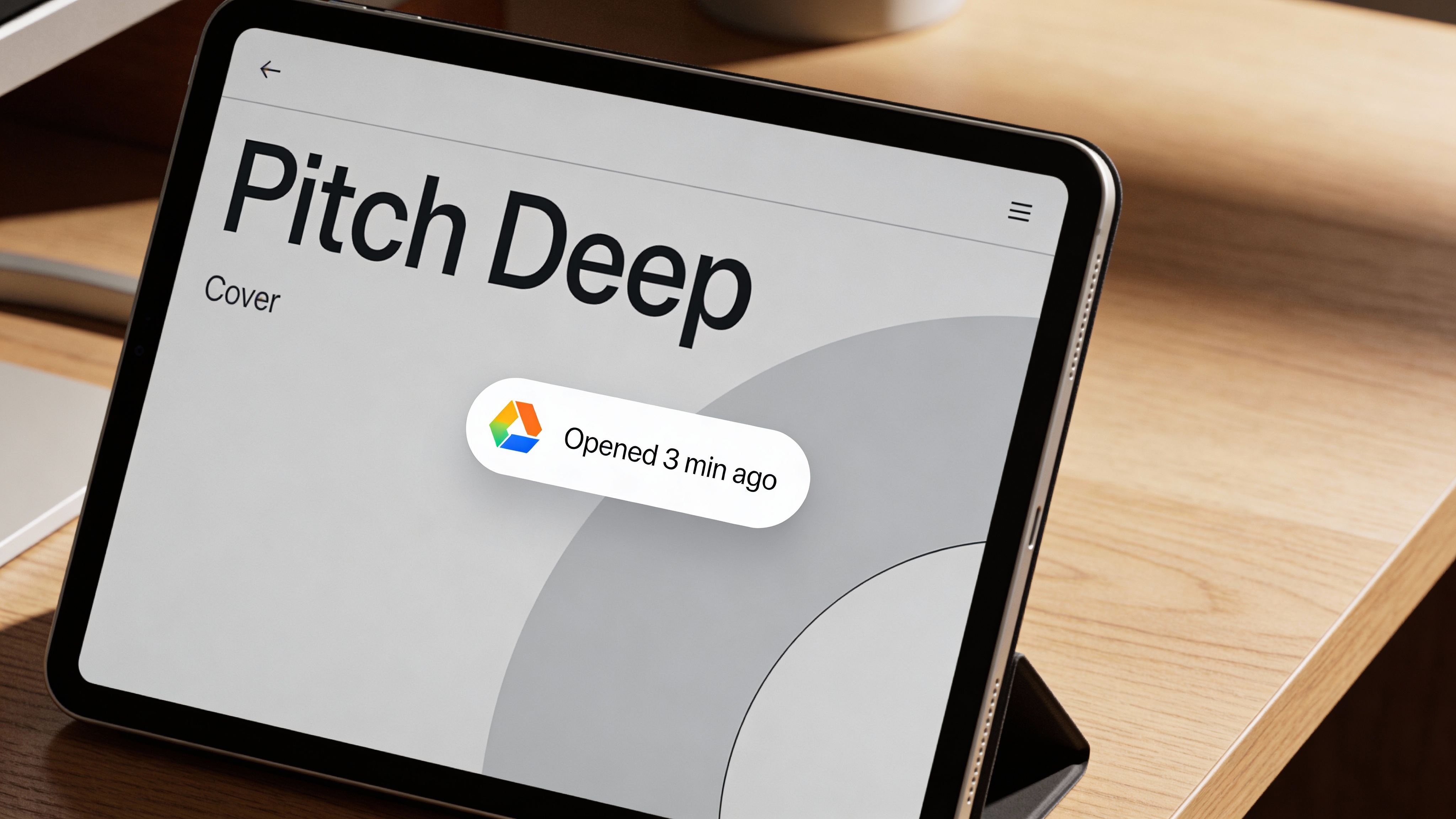
The moment someone opens your deck, you get a notification. Not hours later. Not in a batch report. Right then.
Your phone buzzes: "Sarah at Sequoia opened your deck."
Now you can decide: wait and see how long she spends, or start prepping for a call?
Time Per Slide
This is where it gets useful.
A VC spends 30 seconds on your team slide and 3 minutes on your financials. That tells you something. They're evaluating the business model, not just pattern-matching on founder pedigrees.
Another VC spends 2 minutes on your market size and 10 seconds on traction. They need more proof of market opportunity.
This isn't mind reading. But it's close.
Navigation Patterns
Did they go straight to financials? That's an experienced investor who knows what they're looking for.
Did they flip through quickly and then go back to the beginning? Something caught their eye. They're taking a closer look.
Did they stop at slide 6 and never continue? Something on slide 6 lost them. Worth investigating.
Return Visits
First open: curiosity. Second open: interest. Third open: they're doing diligence, probably showing partners.
Return visits are gold. They signal genuine interest, not just a polite glance.
Setting Up Deck Tracking
Step 1: Create Your Deck
Use Keynote, PowerPoint, Google Slides, or Figma. Design matters, but clarity matters more.
Export as PDF. That's your starting point.
Step 2: Convert to Trackable Flipbook
Upload your PDF to Flipbooker. In about 15 seconds, you have a trackable version.
Your deck looks identical to the PDF. Same design, same flow. But now you have visibility.
Step 3: Get Your Share Link
You get a clean URL:
YOUR_DECK_LINK
That's what you send. No attachments. No file downloads. Just a link that opens instantly.
Step 4: Enable Notifications
Set up alerts for opens. Email, Slack, or mobile push. Know the moment someone engages.
Reading the Signals
High Interest Indicators
- Multiple visits - They keep coming back
- Long time on financials - They're modeling your business
- Team slide attention - They're researching you
- Product slides engagement - They're understanding what you've built
- Links clicked - They're going deeper on your website or demo
Lower Interest Indicators
- Quick skim - 30 seconds total, every slide
- Stopped early - Left before reaching your ask
- No return visit - One and done
- Forwarded but not opened by recipient - Partner wasn't interested enough to look
What to Do With This Data
High interest: Follow up within 24 hours. Reference something specific. "I noticed you spent time on our market size data - happy to share our research methodology."
Moderate interest: Wait a few days. They may be busy. If they return-visit, move faster.
Low interest: Don't stalk. One polite follow-up after a week. Then move on.
Follow-Up Strategies
The Same-Day Response
Deck opened at 2pm. They spent 8 minutes. Lingered on product and team.
Email at 4pm: "Hope the deck was helpful. I'd love to answer questions about specific area they focused on. Happy to jump on a quick call this week."
Not aggressive. Timely. Relevant.
The Pattern-Based Follow-Up
They opened twice: Monday briefly, Thursday for longer.
Email Friday morning: "I saw you took another look - anything I can clarify or expand on?"
Shows you're paying attention without being creepy.
The Silent Follow-Up
They opened once for 45 seconds three days ago. Nothing since.
Wait a week, then: "Wanted to circle back on my deck. Happy to share additional materials or jump on a quick call if helpful."
Standard follow-up. The tracking data just tells you when to send it.
Privacy Considerations
Investors expect this now. Deck tracking is normal in fundraising.
DocSend popularized it. VCs use it themselves when sending fund materials to LPs. It's not surveillance. It's basic engagement data.
That said:
- Don't mention specific slide times in your follow-up (creepy)
- Don't lead with "I saw you opened my deck" (obvious)
- Use insights to inform your approach, not to prove you're watching
The goal is better communication, not gotcha moments.
Beyond the Deck
Data Room Tracking
When you get to diligence, your data room becomes trackable too. Financial models, contracts, cap tables. All can be flipbooks with analytics.
See when lawyers are reviewing documents. Know when the CFO is deep in your numbers. Time your check-ins accordingly.
LP Updates
Once you've raised, use the same approach for LP updates. Know who reads your quarterly letters. Track which portfolio company updates get the most attention.
The Bottom Line
Fundraising is hard enough without operating blind. Deck tracking won't turn a bad pitch into a funded company. But it replaces the guessing game with actual data: who opened it, when, what they focused on, and whether they came back for a second look. That's the difference between a follow-up that lands and one that gets ignored.
For more on document tracking, see our complete analytics guide or explore how tracking works.
FAQs
How long do investors actually spend looking at a pitch deck?
According to DocSend's data, the average investor spends about 2 minutes and 24 seconds reviewing a deck. Successful decks get over 4 minutes; unsuccessful ones get roughly 90 seconds.
Can investors tell they're being tracked?
No. There's no visible tracker. It works like email open tracking — analytics are collected server-side with no popup or notification on their end.
Is deck tracking better than DocSend?
Flipbooker provides similar tracking with a flipbook viewing experience instead of a flat PDF viewer. Both are valid options depending on how you want your deck to feel.
Can I update my deck after sharing the link?
Yes. Update the PDF in Flipbooker and the link stays the same. Investors who visit later see the updated version.
What if a VC insists on a PDF download?
Send both. Share the tracking link and mention a PDF is available if they prefer. Most will use the link.