
 By:
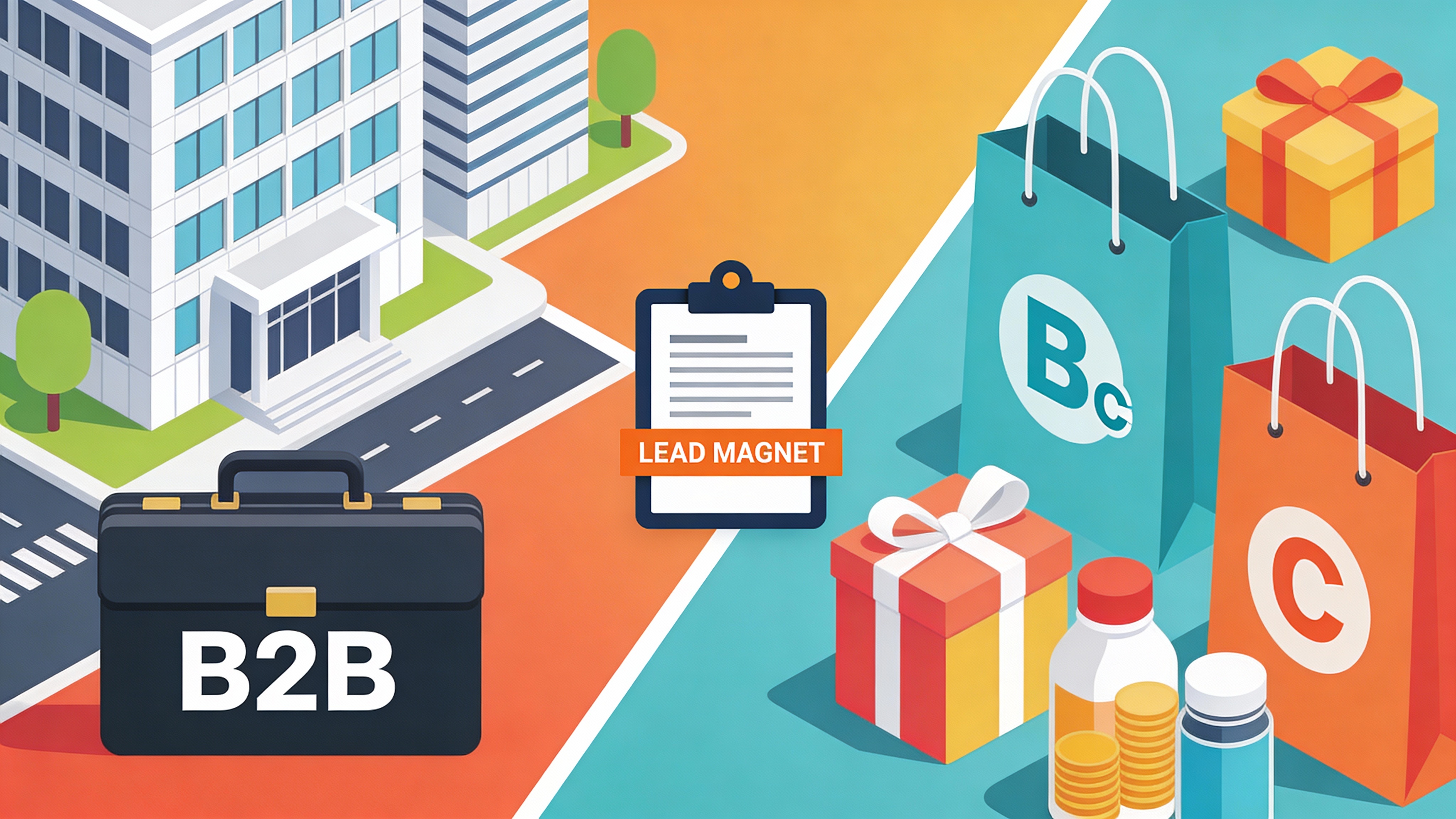
By: The Same Lead Magnet Won't Work for Both
A consumer will give you their email for a 10% discount code. They decide in seconds.
A business buyer needs an ROI calculator, a case study, and approval from three people. They decide in months. As Victoria Heyward, Director of Marketing at Sopro, put it: "B2B purchases rarely involve a single buyer anymore. They're shaped by multi-stakeholder groups, longer sales cycles, and heightened scrutiny at every stage."
Same goal (capture the lead), completely different playbook.
The Core Difference
B2C: Fast, Emotional, Individual
Consumer buying runs on emotion and speed. "I want this" is the whole decision. One person, one click, usually under $100. The entire cycle might last three minutes.
Your lead magnet needs to provide instant value or instant gratification. No one's building a business case for a $12 subscription.
B2B: Slow, Rational, Committee
Business buying runs on logic, process, and consensus. According to Sopro's 2025 State of Prospecting report, the average complex B2B purchase involves around 8 stakeholders, and that number climbs above 10 for enterprise-level deals. Each one has different concerns. The timeline stretches weeks or months. And the stakes run from thousands to millions.
Your lead magnet needs to arm the internal champion with material they can share up the chain. Not just "this is interesting," but "here's why we should buy this."
B2C Lead Magnets That Work
1. Discount Codes
The classic. Give them 10-15% off their first purchase. Popup on site entry or exit intent. "Get 15% off - enter your email." Immediate value, clear action, no friction. This is the baseline for a reason.
2. Free Shipping Thresholds
"Free shipping on orders over $50 - sign up to unlock." Removes a purchase barrier and makes the customer feel like they've earned something. Simple math, strong motivator.
3. Exclusive Access
Early access to sales, new products, or limited items. FOMO is real for consumers. Making them feel like insiders costs you nothing and converts well.
4. Templates and Checklists
A meal planning template. A packing checklist. A budget tracker. These work because people actually use them, and every time they open that template, they think of you.
5. Free Samples
Physical products: free sample with sign-up. Tangible value. Reduces the risk of a first purchase because the buyer gets to try before committing.
6. Quizzes
"Find your perfect product" quizzes that require email for results. Engaging, personalized, and the perceived effort is almost zero. People love learning about themselves.
B2B Lead Magnets That Work
B2B lead magnets need to do something B2C ones don't: survive a forwarding chain. Your lead magnet gets downloaded by a marketing manager, sent to the VP, reviewed by procurement, and maybe forwarded to the CFO. It needs to hold up at every level.
1. Industry Reports
Original research on trends, benchmarks, or challenges in their industry. "2026 State of Document Engagement: What 1,000 Marketers Told Us" is the kind of title that gets shared internally, because it helps the whole team understand their market. Research from Inbox Insight found that 8 in 10 B2B decision makers will hand over their contact details for whitepaper-style content, and 71% share it with colleagues on the buying committee.
2. ROI Calculators
An interactive tool that calculates potential savings or returns. "Calculate how much you're losing to unread proposals." The power here is that the calculator produces numbers the buyer can take to their boss. That's not a lead magnet. That's ammunition for an internal pitch.
3. Case Studies
Detailed stories of how you solved a problem for someone in their shoes. Think "How Company Increased Proposal Close Rates 40% With Document Analytics." Social proof, reduced perceived risk, and concrete results. According to Demand Gen Report, 78% of B2B decision-makers rate case studies among the most valuable content for mid-funnel evaluation.
4. Whitepapers
Deep dives on specific problems. Not a blog post with a gate in front of it. A real, substantial piece that educates a buyer over 15-20 pages. "The Complete Guide to Document Analytics for Sales Teams" works because it positions you as the expert before the buyer ever talks to your sales team.
5. Comparison Guides
Buyers are already comparing. You might as well be the one helping them do it. "Flipbook Software Compared: What to Look For." If it's genuinely objective, you become their research assistant. If it's obviously biased, you become noise.
6. Templates and Frameworks
Tools they can immediately apply: "Sales Proposal Template + Tracking Checklist." These create ongoing value because the buyer uses them weekly, not once. That's repeat brand exposure without buying an ad.
Gating Strategy Differences
B2C Gating: Keep It Light
Ask for email. Maybe first name. That's it.
Long forms kill consumer conversion. They'll abandon if you ask for phone number, company, or role.
B2B Gating: You Can Ask More
Business buyers expect to provide more information for valuable content. They know how this works. If your report is good enough, they'll fill out the form.
For a substantial piece (industry report, detailed ROI calculator):
- Email (required)
- First name (required)
- Company name (helpful)
- Role/title (helpful)
- Company size (helpful for qualification)
The more valuable the content, the more you can ask. But keep it proportional. Research from Brixon Group found that companies using a hybrid model with mostly free content and selectively gated premium pieces see a 72% higher form completion rate than those gating everything.
Domain Restrictions for B2B
Here's a B2B-specific tactic: block personal emails.
If you're targeting enterprise buyers, filter out Gmail, Yahoo, Hotmail. Require work emails.
Why it works:
- Filters out students and researchers
- Gets you actual company information
- Higher quality leads
- Easier to research and qualify
The trade-off: Lower volume, higher quality.
Configure this in your lead capture settings. Flipbooker lets you set domain restrictions on any gated content.
Distribution Differences
B2C Distribution
- Social media ads - Facebook, Instagram, TikTok
- Influencer partnerships - Reach through trusted voices
- Exit intent popups - Catch leaving visitors
- Checkout incentives - Convert at point of decision
- SMS marketing - Direct, high open rates
Speed matters. Impulse matters. Visual matters.
B2B Distribution
- LinkedIn - Where business people actually are
- Content syndication - Publish where your audience reads
- Webinars - Educational events that capture registrations
- Partner co-marketing - Tap into other companies' audiences
- Paid search - Capture high-intent queries
- Email sequences - Nurture over time
Patience matters. Relevance matters. Trust matters.
Measuring Success Differently
B2C Metrics
- Conversion rate - What percentage of visitors sign up
- Cost per lead - Ad spend ÷ leads generated
- Time to first purchase - How quickly leads convert
- Average order value - Are leads spending?
- Lifetime value - Long-term customer value
B2B Metrics
- Lead quality - Are these actual potential customers?
- Sales acceptance rate - How many leads does sales accept
- Pipeline generated - Dollar value of opportunities created
- Deal velocity - How fast do leads move through stages
- Content attribution - Which content influenced which deals
Examples Side by Side
Lead Magnet: Same Category, Different Approach
Fitness industry - B2C: "Get your free 7-day workout plan - enter your email"
Simple, immediate value, low commitment.
Fitness industry - B2B (gym owners): "2026 Gym Membership Benchmarks: Retention Rates, Revenue Per Member, and Marketing Spend Across 500 Gyms"
Data-driven, helps them compare to peers, useful for planning.
Software - B2C: "Start your free trial - no credit card required"
Immediate access, no friction.
Software - B2B: "ROI Calculator: See how much you could save with automated document tracking + Case Study: How Company cut proposal follow-up time 60%"
Helps build internal business case.
Common Mistakes
B2C Mistakes
- Asking for too much information - Email only. Maybe name.
- Not delivering instant value - They want immediate gratification
- Complicated redemption - Make using the offer dead simple
- No urgency - Limited time works for B2C
B2B Mistakes
- Acting like B2C - "Get 20% off" doesn't work for enterprise
- Not enough substance - Thin content burns trust
- Ignoring the committee - Content should be shareable to stakeholders
- Giving up too fast - B2B cycles are long; nurture over months
Getting This Right
The biggest mistake isn't picking the wrong lead magnet type. It's treating B2B and B2C audiences as if they think the same way. They don't. A consumer wants instant payoff. A business buyer wants to look smart in front of their colleagues. Build for that difference, and the leads follow.
For more on lead generation strategy, see our complete lead generation guide or explore lead capture features.
FAQs
How many stakeholders are typically involved in a B2B purchase?
According to Sopro's 2025 State of Prospecting report, the average B2B purchase involves around 4-8 stakeholders, with enterprise deals often requiring 6-10+ approvals. That's why B2B lead magnets need to be shareable and help buyers build internal consensus.
Do B2B buyers actually download whitepapers anymore?
Yes. Research from Inbox Insight shows 8 in 10 B2B decision makers are willing to share contact details for whitepaper content, and 71% share those resources with colleagues on the buying committee.
What's the best lead magnet format for B2C e-commerce?
Discount codes and free shipping offers still convert best for e-commerce. They appeal directly to the impulse-driven, price-sensitive nature of consumer purchases.
Should I block personal email addresses on B2B forms?
If you're targeting mid-market or enterprise, yes. Requiring work emails filters out students and researchers, gives you company data for qualification, and produces higher-quality leads. The trade-off is lower volume.
Can a small business use B2C-style lead magnets?
SMBs are a hybrid. They decide faster than enterprise but still need business justification. Use a B2B-style lead magnet (case study, template, or benchmark report) but keep the form short — email and first name only.